

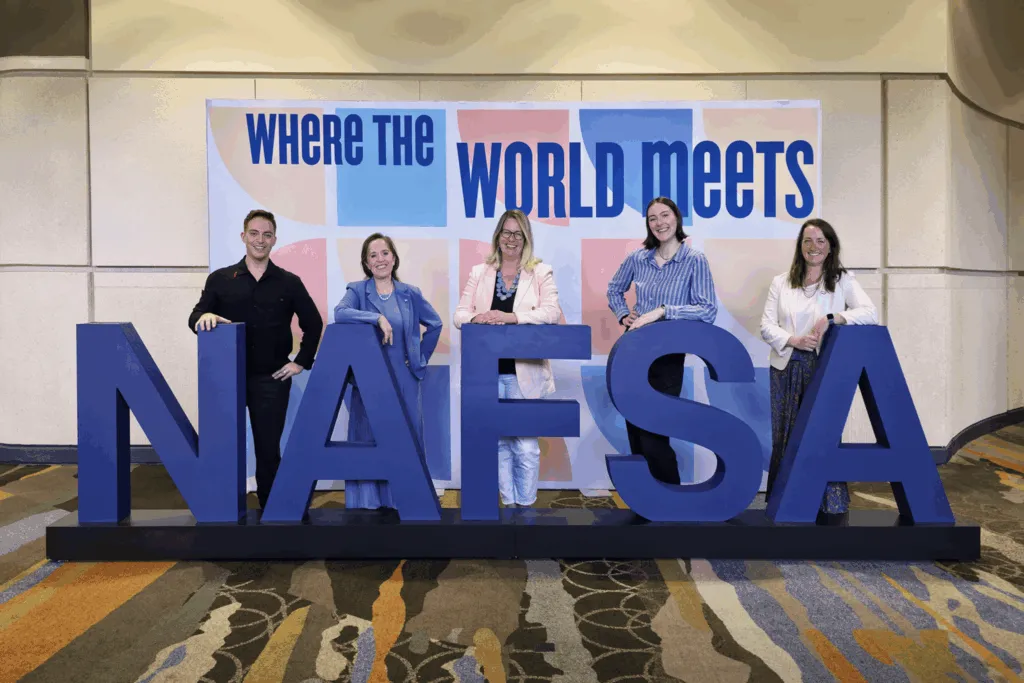
These NAFSA 2026 takeways explore community, curiosity, and the values shaping international education today.Representing AFS Intercultural Programs alongside colleagues from the Alianza Latinoamericana de Educación Intercultural and AFS Interculture Canada, Linda Stuart, Molly Stern, and Pablo Cornejo attended the NAFSA 2026 Annual Conference & Expo and returned with renewed inspiration, meaningful reflections, and a deeper appreciation for the power of global learning and human connection.
NAFSA 2026 Reflections: AFS’s Five Takeaways for International Education
Every year, attending theNAFSA’s Conference feels a little like coming home for the AFS team.
For those who have attended for years, there is a sense of reunion. Familiar faces appear in hallways, conversations pick up where they left off months earlier, and new connections quickly become meaningful ones. At the same time, what continues to make NAFSA special is its ability to welcome newcomers. Each year brings fresh voices, new ideas, and different perspectives that strengthen the international education community.
This year, that sense of belonging felt especially powerful. More than ever, intercultural encounters and intercultural education were not simply topics discussed in conference sessions, they were lived throughout the event. In conversations between colleagues from different regions, in the exchange of diverse perspectives, and in the relationships built across cultures, the values at the heart of international education came to life.
As we reflect on our experience at NAFSA 2026, five key ideas stay with us after the conference: community, curiosity, intentionality, solidarity, and hope.
NAFSA 2026 Takeaways
- Community remains the foundation of international education.
- Global competence requires intentional design.
- Curiosity is stronger than fear.
- Partnerships create meaningful impact.
- Hope and high standards must go hand in hand.
These themes appeared throughout keynote sessions, professional conversations, and chance encounters across the conference. Together, they tell a story about where the field of international education is today, and where it may be heading next.
1. Community Remains the Foundation of International Education
What makes NAFSA unique is not only the scale of the event, but the community it brings together.
Throughout the week, conversations moved easily between long-time colleagues and first-time attendees. Experienced professionals welcomed new voices into the field, while emerging leaders brought fresh perspectives to ongoing discussions. The result was a dynamic learning environment where knowledge, ideas, and experiences flowed across generations, institutions, and regions.
This sense of community is one of international education’s greatest strengths. It reminds us that our work is not carried out by individual organizations alone, but by a global network of educators, practitioners, and advocates committed to creating opportunities for intercultural learning and exchange.
2. Global Competence Requires Intentional Design
The NAFSA 2026 theme, Global by Design, offered one of the most meaningful invitations of the week.
Internationalization today requires more intentionality. Global competence does not emerge by accident. Institutions, educators, and organizations must actively create opportunities for people to engage across differences, develop intercultural competence, and build the skills needed to thrive in a globally interconnected world.
Throughout the conference, conversations repeatedly returned to this idea. Whether discussing partnerships, global learning programs, student mobility, or community engagement, participants emphasized the importance of designing experiences that foster meaningful intercultural encounters.
For organizations like AFS Intercultural Programs, this message strongly resonated with our mission: creating learning experiences that help individuals develop the knowledge, skills, and attitudes needed to navigate cultural differences with confidence and empathy.
3. Curiosity Is Stronger Than Fear
One of the most powerful observations from NAFSA 2026 was the collective commitment to curiosity.
For many attendees, that commitment felt especially meaningful this year. As conversations unfolded across the conference, a recurring theme emerged: choosing curiosity instead of fear when engaging with differences in culture, religion, generation, race, identity, and lived experience. In a moment when division often dominates public discourse, that choice felt both intentional and hopeful.
Across discussions about culture, religion, language, identity, generation, and lived experience, participants consistently highlighted the importance of remaining open to learning from others.
This mindset lies at the heart of intercultural learning. Progress begins when people are willing to listen, ask questions, and explore perspectives different from their own.
The conference itself modeled this principle. Bringing together professionals from diverse backgrounds and regions, NAFSA created countless opportunities for meaningful intercultural encounters, exactly the type of experiences the field seeks to foster for learners around the world.
4. Partnerships Create Meaningful Impact
Another idea surfaced repeatedly throughout the week: meaningful disruption often begins with meaningful partnerships.
The conference itself demonstrated this principle. Bringing together more than 6,000 professionals committed to building bridges across countries and communities, expanding access to global learning, and fostering more compassionate forms of leadership, NAFSA became a powerful example of how collaboration can challenge narratives of division and create space for meaningful change.
Many speakers challenged attendees to think about how complex global challenges can only be addressed through collaboration. Whether expanding access to international education, advancing sustainability efforts, supporting student success, or strengthening global learning opportunities, lasting impact requires people and organizations working together.
This spirit of partnership was visible everywhere.
Conversations focused on building bridges between countries, institutions, sectors, and communities. New collaborations emerged alongside long-standing relationships. Participants shared resources, expertise, and ideas with a common goal: creating more opportunities for people to learn, connect, and grow across cultures.
These exchanges reinforced an important lesson. The future of international education will not be built by individual organizations acting alone. It will be shaped through partnerships grounded in trust, shared purpose, and mutual learning.
5. Hope and High Standards Must Go Hand in Hand
Perhaps the most inspiring NAFSA takeaway was the relationship between hope and professional responsibility.
Throughout the conference, speakers encouraged attendees to remain optimistic while continuing to uphold high standards in their work. Human connection, ethical leadership, and educational excellence were presented not as separate goals, but as complementary ones.
Several keynote messages emphasized that hope is not passive. It is something we actively cultivate through our decisions, actions, and commitment to shared values.
One message resonated particularly strongly. During a keynote conversation, Leila Cobo reflected on what gives her hope today: people who continue to maintain high standards. Combined with the leadership demonstrated throughout the conference by NAFSA CEO Dr. Fanta Aw, the message was clear. Hope is sustained not only through optimism, but through professional integrity, human warmth, and a commitment to excellence even in challenging times.
For professionals working in international education and intercultural learning, this means continuing to create opportunities for understanding, even when circumstances are challenging. It means preserving human warmth while maintaining rigor. And it means believing that meaningful change remains possible.
The stories shared throughout the week reflected exactly that.
Conference participants described study abroad experiences, intercultural friendships, hosting journeys, and educational opportunities that transformed the way they understood themselves and others. Many spoke about moments that happened years or even decades ago, yet continue to influence their lives today.
These stories served as a powerful reminder that the impact of global education extends far beyond a single program or event. It lives on through the relationships people build, the communities they strengthen, and the opportunities they create for future generations.
Our NAFSA takeaways for the Future of International Education
As the conversations from NAFSA 2026 continue to resonate, one message feels increasingly clear.
The international education community is becoming more intentional about the values it seeks to advance. Curiosity instead of fear. Collaboration instead of isolation. Solidarity instead of division.
These values were not only discussed throughout the conference, they were demonstrated in practice. They appeared in conversations between colleagues from different regions of the world, in partnerships formed across sectors, and in the collective determination to continue expanding access to global learning and intercultural education.
Some of the most memorable moments happened away from the main stage. Throughout the week, former exchange participants, host families, volunteers, and educators stopped by the AFS booth to share stories of how intercultural experiences had shaped their lives. Some spoke about programs they joined decades ago. Others recalled welcoming students into their communities or forming friendships that transformed their understanding of the world. Despite their different journeys, many described the same outcome: an experience that sparked something profound and continues to inspire them today.
For AFS NAFSA 2026 takeaways reinforced the importance of preserving these values while continuing to innovate. The future of global competence depends on our ability to create inclusive, intentional, and transformative learning experiences that prepare people to engage with an increasingly interconnected world.
As we move forward, we do so with greater clarity about the values that guide our work, deeper appreciation for the community that sustains it, and renewed determination to strengthen the field of international education.
And so we return to the five ideas that opened this reflection: community, intentionality, curiosity, partnership, and hope. They are not only our NAFSA 2026 Takeaways. They are what we carry forward from it.